
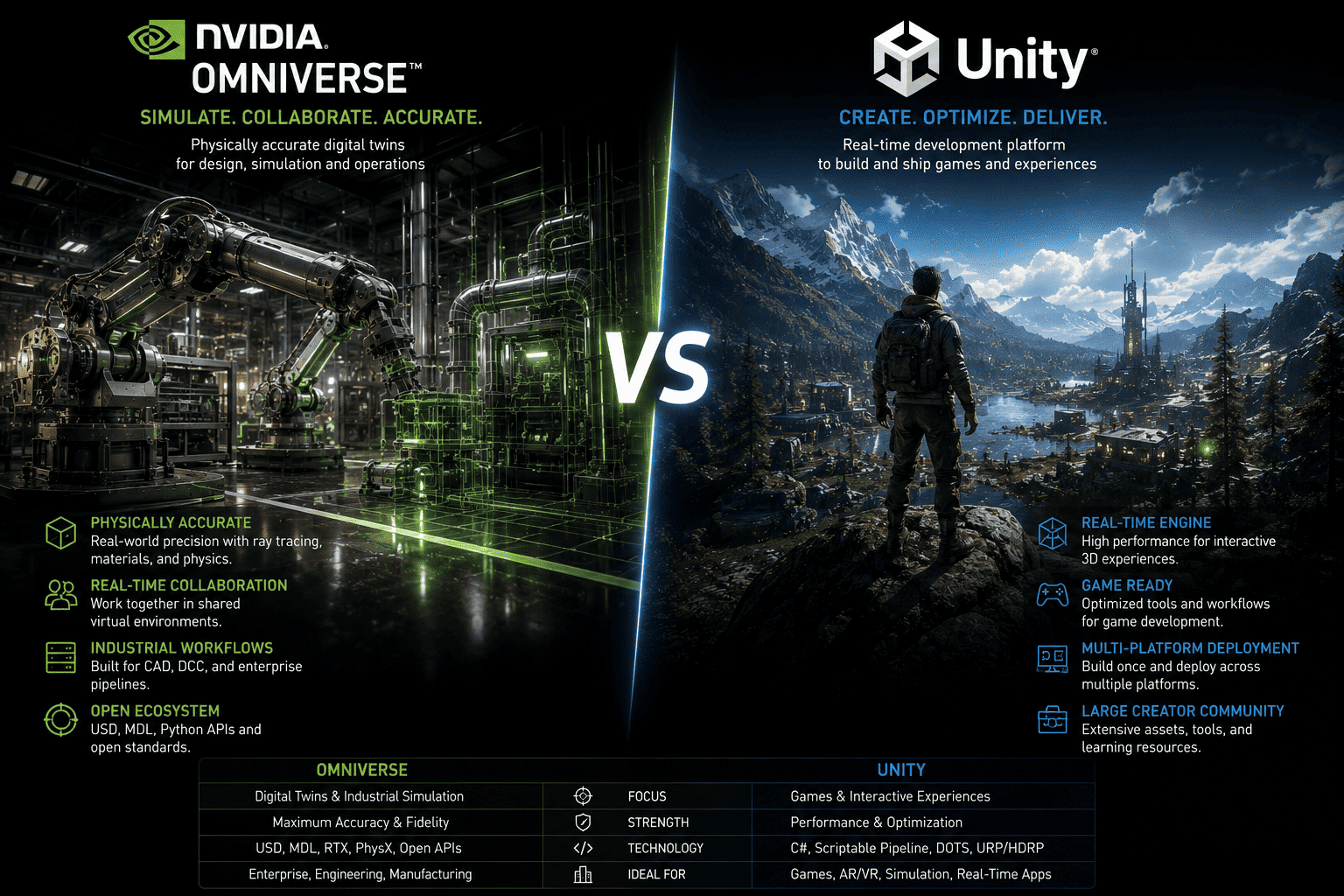
If you’ve spent any time around 3D, XR, or digital twin conversations lately, you’ve probably heard someone say “we should look at Omniverse” in a meeting where everyone was quietly thinking “isn’t that just Unity with ray tracing?” It isn’t. And the difference matters more than the marketing pages let on — because choosing the wrong one costs you months, not days.
At TwinReality, we work at the intersection of both worlds — the AR glasses and spatial computing devices where experiences get delivered, and the simulation platforms where serious 3D content increasingly gets built. So here’s the honest, practitioner’s answer to a question we keep getting asked.
The one-line answer
Unity is a game engine for building and shipping an application. Omniverse is a simulation and collaboration platform for connecting tools and producing physically accurate ground truth.
If that sentence fully lands for you, you can stop reading. If it sounds like two ways of saying the same thing — keep going, because the confusion is exactly where expensive mistakes happen.
Why they look similar (and why that’s misleading)
On the surface, the two feel like cousins. Both give you a real-time 3D viewport. Both have a scene hierarchy, materials, lighting, physics, and scripting. Both even use NVIDIA’s PhysX physics engine under the hood. Open either one and you’ll feel at home within an hour.
But the resemblance is skin-deep, because the two platforms are built for opposite ends of the 3D pipeline — and they make opposite trade-offs at almost every layer beneath the viewport.
The philosophical difference in one image
Think of it this way:
Unity is a destination. Assets flow in from everywhere, get assembled, and leave as a finished application. The scene exists to become a build.
Omniverse is a hub. Tools and data connect to it and stay connected. The scene exists to be the shared, accurate, always-current model that everything else — design reviews, robot training, marketing renders, AI pipelines — plugs into.
Neither philosophy is better. They’re answers to different questions.
A side-by-side that actually helps
| Unity | NVIDIA Omniverse | |
|---|---|---|
| Core purpose | Build & ship an interactive app | Aggregate, simulate & collaborate on 3D data |
| Typical output | A game/app running on a device | Digital twins, synthetic data, photoreal renders, streamed 3D |
| Rendering | Rasterised, speed-first | RTX path-traced, accuracy-first |
| Physics (both PhysX) | Tuned for game feel | Tuned for real-world fidelity |
| Scene format | Proprietary | OpenUSD (open, interoperable) |
| Runs on | Phones, headsets, consoles, browsers | RTX workstations & cloud GPUs |
| Deploys to AR glasses? | Yes — its home turf | Not directly; export or stream |
| Licensing | Per-seat/revenue-based tiers | Free for development, production & redistribution (as of 2026) |
| Best mental model | A destination | A hub |
The question that actually decides it
Forget feature lists. Ask yourself one question:
Is my end product an application, or is it accurate 3D truth?
Choose Unity if: your deliverable runs on a device. A mobile AR try-on. A training app on Quest. An AR game. A branded experience — the kind of interactive content that lives alongside things like AR filters for brands. Anywhere the user holds or wears the endpoint, Unity (or Unreal) is your answer.
Choose Omniverse if: your deliverable is a faithful digital version of something physical. A factory layout you want to validate before pouring concrete. A warehouse where you’ll train robot fleets virtually. A product you need rendered with physical accuracy across a thousand marketing variations. Synthetic camera data to train a vision model. This is why Indian manufacturers like Ola Electric built their factory digital-twin platform on Omniverse, and why Reliance is using it to plan its Jamnagar solar gigafactory — these are truth problems, not app problems.
Choose both if: you’re doing what we think is the most interesting work happening right now — which brings us to the part most comparisons miss.
Unity: a destination
Unity’s entire architecture is organised around one goal: shipping a runtime application to a device. You import assets, assemble a scene, write gameplay or interaction logic, and export a build that runs on a phone, a Quest headset, a console, or a browser.
Everything about Unity is optimised for that endpoint:
Its renderer is rasterised and aggressively performance-tuned, because it must hit 60–90fps on a mobile chipset, not on a workstation GPU. Its physics is tuned for game feel — believable, responsive, cheap to compute — rather than laboratory accuracy. Its asset pipeline is a one-way street: content flows in, gets baked and compressed, and ships out as part of a build. And its scene format is proprietary, which is fine, because a Unity scene’s job is to become an app, not to be shared with other software.
For AR specifically, this is why Unity has dominated for a decade. When we cover devices like the Xreal One Pro or the Ray-Ban Meta smart glasses on this site, nearly every third-party experience running on hardware like that traces back to Unity (or Unreal). If your deliverable is an experience running on a device in someone’s hand or on someone’s face, Unity is not just an option — it’s the default.
Omniverse: a hub
Omniverse starts from a completely different question: not “how do I ship an app?” but “how do I get every 3D tool, every dataset, and every team looking at one accurate, living model of something real?”
That reframing explains every design decision NVIDIA made:
It’s built on OpenUSD, not a proprietary format. Universal Scene Description — the open scene format originally developed at Pixar — is the beating heart of Omniverse. USD isn’t just a file type; it’s a live, layered scene graph that Maya, Blender, Revit, CATIA, Unreal and dozens of other tools can all read and write. Omniverse doesn’t want to replace your tools. It wants to connect them, with one source of truth in the middle.
Its rendering is physically accurate, not just pretty. Omniverse renders with RTX path tracing — light behaves the way light actually behaves. That sounds like a luxury until you realise why it exists: if you’re using a virtual factory to train a computer-vision model, or validating how a sensor perceives a scene, “looks about right” is worthless. You need ground truth. The render isn’t the product; the accuracy is.
Its physics is simulation-grade, not game-grade. Same PhysX foundation as Unity, tuned in the opposite direction — toward real-world fidelity for robotics, manipulation, and industrial processes, where the point is to predict what will happen in reality, not to feel fun.
It doesn’t ship apps to phones. Omniverse runs on RTX workstations or cloud GPUs. Its outputs are renders, simulations, synthetic training data, and streamed experiences — not an APK you sideload onto a headset.
The part nobody tells you: they’re a pipeline, not rivals
Here’s the insight that reframes the whole “versus” question: Omniverse and Unity aren’t competing for the same seat. They’re two stations on the same assembly line.
A realistic modern workflow looks like this:
- Build truth in Omniverse. Aggregate CAD, scans, and BIM data into one OpenUSD scene. Simulate it. Validate it. Render it with physical accuracy. This is your single source of truth.
- Deliver experience through Unity. Export or translate the relevant slice of that USD scene into Unity, optimise it for mobile-class hardware, add interaction, and ship it to the device in someone’s hand — or increasingly, on their face.
The physically accurate factory twin becomes the lightweight AR walkthrough a site manager views through smart glasses. The path-traced product configurator becomes the mobile AR try-before-you-buy experience. The simulation feeds the experience; the experience never had to compromise the simulation.
This upstream/downstream split is also visible in the market. Boutique integrators who started in Unity for industrial visualisation have been migrating their simulation work to Omniverse and OpenUSD — while keeping game engines for the delivery layer. The tools found their natural positions once teams stopped treating them as substitutes.
And with smart glasses finally maturing into genuine computing devices — a shift we’ve tracked closely, from Meta’s push into its own smart glasses to the growing question of everyday practicality like prescription support — the demand for this exact bridge is only going to grow. The industrial world is building accurate twins in Omniverse. The consumer world is putting displays on faces. Somebody has to connect the two ends of that pipeline.
What changed in 2026 (and why it lowers the stakes)
One practical update worth knowing: as of mid-2026, NVIDIA made Omniverse free for development, production, and even redistribution — no enterprise subscription required (paid support remains optional). The old cost barrier that made “let’s just try Omniverse” an expensive experiment is gone. The main remaining requirement is hardware: you’ll need an RTX GPU to run it seriously.
That means the honest advice today isn’t “pick one.” It’s: keep Unity for everything device-facing, and start learning OpenUSD and Omniverse for everything truth-facing — because the cost of exploring the second one just dropped to zero.
The bottom line
“Omniverse vs Unity” is the wrong frame. The right frame is:
- Unity answers: how do I put an experience on a device?
- Omniverse answers: how do I create and maintain an accurate digital version of something real?
Most serious spatial-computing work over the next few years will need both answers — accurate twins upstream, delivered experiences downstream. The teams that understand both ends of that pipeline, and how OpenUSD carries content between them, are the ones who’ll be genuinely hard to replace.
That intersection — where physically accurate simulation meets the AR devices people actually wear — is exactly where we’re focused at TwinReality. If you’re exploring what Omniverse, digital twins, or OpenUSD workflows could mean for your product or content pipeline, get in touch — we’d love to talk.
Related reading on TwinReality:

