Virtual Reality for defense​

Virtual Reality in military training enhances instruction and hones the soldiers’ skills.

One of the founding fathers of the United States, Benjamin Franklin, once remarked that if you don’t plan, you plan to fail. He always communicated key topics in a funny and straightforward manner.

 Any general will acknowledge that each war requires a thorough strategy and years of planning.

Without all that planning and preparation, entering combat operations would be a disaster waiting to happen. There will undoubtedly be a horrible defeat for that regiment or unit.
Virtual reality for defense

 The importance of training combat and support personnel in the military services cannot be overstated. To experience triumph on the battlefield, a well-trained, disciplined, and inspiring force is required.

The government of all nations are very advanced, and the use of cutting-edge technologies has strengthened their strategic and tactical advantages. 

It has become very crucial to train everyone on these technologies if we want to have a fighting force that is completely effective. Traditional training methods face numerous difficulties, and new technologies have emerged to support total training requirements.

Virtual reality is now acknowledged as one of the most fascinating technologies that helps improve human potential and raise performance. 

According to PWC, virtual reality (VR) learners learn 4 times more quickly and with 275% more confidence than traditional classroom learners. A remarkable discovery is the almost threefold rise in confidence, especially when people are required to make important choices.
Virtual reality is not unfamiliar to the younger generation; many have at least heard about it from friends or peers or have experienced it themselves. The military establishment is taking steps to incorporate virtual reality into military training programs as a result of realizing this.

The training of fresh recruits and cadets will benefit most from VR instruction. The boot camp itself needs to incorporate this kind of training. 

Using VR, it is inexpensively possible to receive training on weapons and weapon systems, learn safe handling techniques, perform maintenance, develop situational awareness, and become proficient in all skill sets.

These synthetic training environments—also known as virtual reality scenarios—help the young soldier create a number of bloodless war scenarios. They are exposed to various terrains, simulated weather, and logistical difficulties that they would possibly face in actual combat circumstances. 

Every military situation has the potential to be life or death, and only a highly skilled and qualified soldier can carry out the mission’s objectives under pressure.

The best armed forces in the world, including the US Army, have already realized this and are actively investigating the potential military uses for virtual reality. To create simulations and mission rehearsals for its troops, they are constantly contacting defense technology businesses.

Creating fighting situations and solutions for chemical, biological, and cyberwarfare scenarios would also be included. They have realized that virtual reality training reduces the cost of logistics and field training with live ammunition, and As VR instruction is available around-the-clock, there are no time limits. 

The Integrated Moving Target Simulator, often known as the Stinger Training Dome, is a virtual reality training simulator used by the US Army. To train and improve the abilities of soldiers who must operate the army’s MANPADS, or man-portable air defense systems, this simulator offers a 360-degree battle scenario.

These are portable surface-to-air missiles that pose a severe danger to helicopters, unmanned aerial vehicles (UAVs), drones, low-flying aircraft, etc. Examples include the US Stinger, Russian Verba, Chinese QW-4, etc. 

This training improves the soldier’s expertise and confidence in their ability to carry out the required combat operations in the actual theatre of battle. Not far behind is the Indian military apparatus.

Many non-military circumstances, such pandemics and climatic emergencies, frequently require the assistance of the military. They are frequently requested on short notice since civilian establishments find it difficult to handle them.

 Virtual reality can be used to create training on these scenarios for all army personnel regarding emergency and catastrophe management. During national emergencies, the acquired abilities will have a significant impact on saving lives and reducing property damage.

In essence, militaries recognize the necessity to constantly be ready to address a nation’s security issues in light of today’s dynamic and complicated geopolitical environments.

 It is possible to emphasize how important it is to keep ahead of the competition and anticipate enemy challenges. Intense training and regular competency and capability reviews help to enhance preparedness technologies, including VR is crucial to achieving those objectives. 

For quick deployment, it is necessary to identify efficient use cases and develop solutions. The bottom line is that in order to develop such technological capabilities, technology businesses and VR solution suppliers need to actively collaborate with military commanders


Revolutionizing Marketing with AI in the Metaverse: How Brands Can Maximize Their Presence in the Virtual World

AI in the Metaverse:

The rise of the metaverse has opened up new possibilities for brands to connect with their customers in a virtual world. With the help of AI, marketers can now create personalized experiences that engage and delight customers.

 In this blog, we will discuss how AI is revolutionizing marketing in the metaverse and how brands can maximize their presence in the virtual world.

Virtual reality was once the dream of science fiction. But the internet was also once a dream, and so were computers and smartphones. The future is coming.

AI for Marketing effectively in marketing of cafe
  • Personalized Experiences

One of the biggest advantages of AI in marketing is the ability to create personalized experiences for customers. In the metaverse, AI-powered chatbots can engage with customers and provide them with personalized recommendations based on their preferences and past interactions. 

For example, if a customer is looking to buy a new pair of shoes, a chatbot can recommend shoes based on their size, style preferences, and past purchases.

In addition to chatbots, AI-powered virtual assistants can also provide personalized experiences in the metaverse. Virtual assistants can help customers navigate through virtual stores and provide them with real-time assistance.

 They can also provide customers with product recommendations and help them find the perfect item.

  • Customer Data Analysis

Another advantage of AI in marketing is the ability to analyze customer data in real time. In the metaverse, marketers can track customer behavior and interactions to gain insights into their preferences and purchasing behavior.

With this information, marketers can create targeted campaigns that resonate with their customers.

For example, if a customer frequently purchases athletic apparel in the metaverse, a marketer can create a campaign that showcases new athletic apparel releases. 

By analyzing customer data, marketers can create campaigns that are relevant and personalized, leading to higher engagement and conversion rates.

  • Virtual Product Placement

Virtual product placement is another way that brands can maximize their presence in the metaverse. By placing virtual products in popular virtual locations, brands can increase their visibility and reach new customers. 

For example, a virtual fashion brand can place its products in a popular virtual fashion show, allowing customers to see the products in action.

Virtual product placement can also be used in virtual games and experiences. For example, a gaming company can place virtual items in their game that are branded with a partner company’s logo. 

This allows both companies to increase their visibility and reach a wider audience.

  • Social Media Integration

Finally, social media integration is another way that brands can maximize their presence in the metaverse. With the help of AI, brands can integrate their social media channels into the metaverse, allowing customers to connect with them in new and innovative ways.

 For example, a brand can create a virtual social media experience that allows customers to interact with their products and services in a virtual environment.

Social media integration can also be used to create social media campaigns that target customers in the metaverse. By analyzing customer data and behavior, brands can create campaigns that are personalized and relevant to their customers.

 For example, a brand can create a virtual scavenger hunt that leads customers to their virtual store, increasing engagement and awareness.

There's nobody who works in VR saying, "Oh, I'm bored with this." Everybody comes back.

AI for Marketing of some cafe

Conclusion

In conclusion, AI is revolutionizing marketing in the metaverse by enabling personalized experiences, customer data analysis, virtual product placement, and social media integration. 

With these tools, brands can maximize their presence in the virtual world and connect with their customers in new and innovative ways.

 As the metaverse continues to grow and evolve, brands that embrace AI-powered marketing strategies will be best positioned to succeed in this new and exciting space.

Metaverse Token: 7 Most Popular Metaverse Tokens Right Now

A metaverse token is a digital asset that is used to represent ownership of virtual items or real-world assets in a virtual world or metaverse. 

These tokens are typically built on blockchain technology, such as Ethereum or Binance Smart Chain, and enable users to buy, sell, and trade virtual assets within the metaverse ecosystem. 

Metaverse tokens can be used to purchase virtual land, digital collectibles, or other virtual assets, and they can also be used to participate in various metaverse platforms or games. 

These tokens often have unique use cases within their respective metaverse ecosystem and can provide holders with various benefits such as access to exclusive content or increased earning potential.

The metaverse is a virtual space that is becoming increasingly popular, with millions of users interacting with each other and virtual objects. The metaverse has led to the development of metaverse tokens, which are digital assets used to represent ownership of virtual items or real-world assets in the virtual world.

 In this blog, we will discuss the 7 most popular metaverse tokens right now and their potential for growth in the future.

Beautiful AI generated women

Virtual reality is all about democratizing storytelling. It gives people more control over the experience. Instead of trying to force a story upon you, we try and give you this huge playground through which you will create stories that you will then share through this medium.

  • MANA (Decentraland)

MANA is the native token of Decentraland, a virtual world built on the Ethereum blockchainThe token is used to buy virtual land in the Decentraland world, which can then be used to build and monetize virtual experiences. 

MANA has a market capitalization of over $2 billion and has seen significant growth in recent months due to the popularity of Decentraland.

  • SAND (The Sandbox)

SAND is the native token of The Sandbox, a virtual gaming platform built on the Ethereum blockchain. The token is used to purchase virtual land in The Sandbox world and can also be used to buy and sell virtual assets within the platform. 

SAND has a market capitalization of over $1 billion and has seen significant growth in recent months due to the increasing popularity of The Sandbox.

  • AXS (Axie Infinity)

AXS is the native token of Axie Infinity, a virtual gaming platform built on the Ethereum blockchain. The platform allows users to collect and battle digital creatures called Axies, and AXS is used to purchase these creatures and participate in the platform’s ecosystem.

 AXS has a market capitalization of over $4 billion and has seen significant growth in recent months due to the increasing popularity of Axie Infinity.

  • ENJ (Enjin)

ENJ is the native token of Enjin, a platform that enables the creation and monetization of virtual assets. The platform allows users to create and trade virtual assets, and ENJ is used as a form of payment for these assets.

 ENJ has a market capitalization of over $1 billion and has seen significant growth in recent months due to the increasing popularity of NFTs (non-fungible tokens).

  • FLOW (Flow)

FLOW is the native token of Flow, a blockchain platform designed for the development and deployment of decentralized applications. The platform is used for the creation of virtual worlds, games, and other digital assets. 

FLOW has a market capitalization of over $2 billion and has seen significant growth in recent months due to the increasing popularity of NFTs and virtual worlds.

  • WAXP (WAX)

WAXP is the native token of the WAX blockchain, a platform designed for the creation and trading of virtual assets. The platform allows users to create and trade virtual items and NFTs, and WAXP is used as a form of payment for these items.

 WAXP has a market capitalization of over $1 billion and has seen significant growth in recent months due to the increasing popularity of NFTs and virtual assets.

  • YGG (YGG)

YGG is the native token of Yield Guild Games, a decentralized gaming platform that enables users to earn income by playing games. The platform allows users to earn cryptocurrency by participating in games and other virtual activities, and YGG is used as a form of payment for these activities.

 YGG has a market capitalization of over $1 billion and has seen significant growth in recent months due to the increasing popularity of gaming and virtual worlds.

Virtual reality created a God particle

Virtual reality is like dreaming with your eyes open.

Conclusion:-

In conclusion, the emergence of metaverse tokens has opened up new opportunities for users to participate in virtual worlds and digital ecosystems.

 These tokens allow for ownership and transfer of virtual assets, and they provide unique use cases and benefits within their respective metaverse ecosystems. As the popularity of the metaverse continues to grow, we can expect to see more development in this space, including the emergence of new metaverse tokens and the integration of existing tokens into new virtual environments. 

As always, it’s important to remember that investing in metaverse tokens involves risks and that users should always conduct their due diligence and research before making any investment decisions. Nonetheless, the potential for metaverse tokens to revolutionize the way we interact with virtual worlds is an exciting prospect that is worth keeping an eye on in the years to come.

The challenges of building the metaverse.

 The term “Metaverse” has been with us since 1992, appearing in Neal Stephenson’s novel “Snow Crash”, where he envisioned a dystopian future and the in-Virtual Reality existence of the next generation of the internet. 

The concept of a fully-realized metaverse has been the subject of fascination and speculation for years. The idea of a fully immersive virtual world has been explored in various forms in books, movies, and video games.

 However, building such a complex and interconnected virtual world presents a host of challenges that must be overcome before the metaverse can become a reality. 

"Metaverse isn't a thing a company builds. It's the next chapter of the internet overall."

Typical lavish house built in metaverse

In this blog, we will explore the challenges of building the metaverse, including technical, economic, regulatory, and social hurdles.

Technical Challenges

One of the most significant challenges facing the development of the metaverse is technical in nature. Creating a seamless, immersive experience that can support millions of users simultaneously requires enormous amounts of computing power and bandwidth. 

The sheer scale of the metaverse means that even small inefficiencies in the underlying infrastructure can have a significant impact on performance and user experience.

To support the scale and complexity of the metaverse, new technologies and computing paradigms will need to be developed. For instance, current cloud computing architectures will not be sufficient to support the immense amounts of data and computational requirements that the metaverse will demand.

Furthermore, the metaverse will require standardization across different platforms and devices. Developing a consistent and universal set of standards will require coordination across a wide range of stakeholders, including hardware manufacturers, software developers, and content creators.

Economic and Regulatory Hurdles

In addition to technical challenges, there are also economic and regulatory hurdles to overcome. Building the metaverse will require massive investments in hardware, software, and content creation. 

Furthermore, the metaverse will likely operate across national borders, presenting a range of legal and regulatory challenges related to data privacy, intellectual property, and taxation.

One major economic challenge is the question of who will fund the development of the metaverse. Most current investment in virtual worlds is focused on gaming and entertainment applications, but the development of a true metaverse will require much greater investments. The financial risks and uncertainty associated with such large-scale investments may deter many potential investors.

Moreover, the metaverse will require a new economic model that supports sustainable growth and development. For instance, the current economic models of virtual worlds, which rely heavily on microtransactions and in-game purchases, may not be suitable for the metaverse.

Regulatory issues will also need to be addressed, including questions about data privacy, intellectual property, and taxation.

 The metaverse will operate across multiple jurisdictions, and it may be challenging to create a consistent regulatory framework that respects the sovereignty of different nations while still ensuring that the metaverse operates in a safe and ethical manner.

Social and Inclusivity Challenges

Another challenge facing the development of the metaverse is ensuring that it is inclusive and accessible to all. Virtual worlds have historically been criticized for being exclusionary, with many early online communities being hostile to women, people of color, and other marginalized groups. 

The metaverse must be designed with inclusivity in mind, and efforts must be made to ensure that it does not perpetuate the same biases and inequalities that exist in the physical world.

To build an inclusive metaverse, designers and developers must prioritize accessibility and consider the needs of diverse user groups. For instance, the metaverse must be designed with accessibility features for people with disabilities, such as those with visual or hearing impairments.

Furthermore, the metaverse must also be designed with social inclusivity in mind. This includes combating hate speech, online harassment, and other forms of abusive behavior that can create hostile environments for marginalized groups. 

Social norms and behavioral expectations must be established and enforced to create a positive and welcoming environment for all users.

Actual building the metaverse

“This metaverse is going to be far more pervasive and powerful than anything else. If one central company gains control of this, they will become more powerful than any government and be a god on Earth.”

Conclusion

In conclusion, building the metaverse is a massive undertaking that requires solving significant technical, economic, regulatory, and social challenges. 

The metaverse will require new technologies, computing paradigms, and economic models to support its scale and complexity. Regulatory issues related to data privacy, intellectual property, and taxation will also need to be addressed to ensure that the metaverse operates ethically and safely. 

Additionally, the metaverse must be designed with inclusivity in mind to create a positive and welcoming environment for all users. Despite these challenges, the potential benefits of a fully-realized metaverse are immense, offering new opportunities for social connection, entertainment, and commerce. 

Therefore, it is crucial that all stakeholders work together to overcome these challenges and build a metaverse that is inclusive, accessible, and beneficial to all.

VR for the Mining Industry ​

VR for the Mining Industry

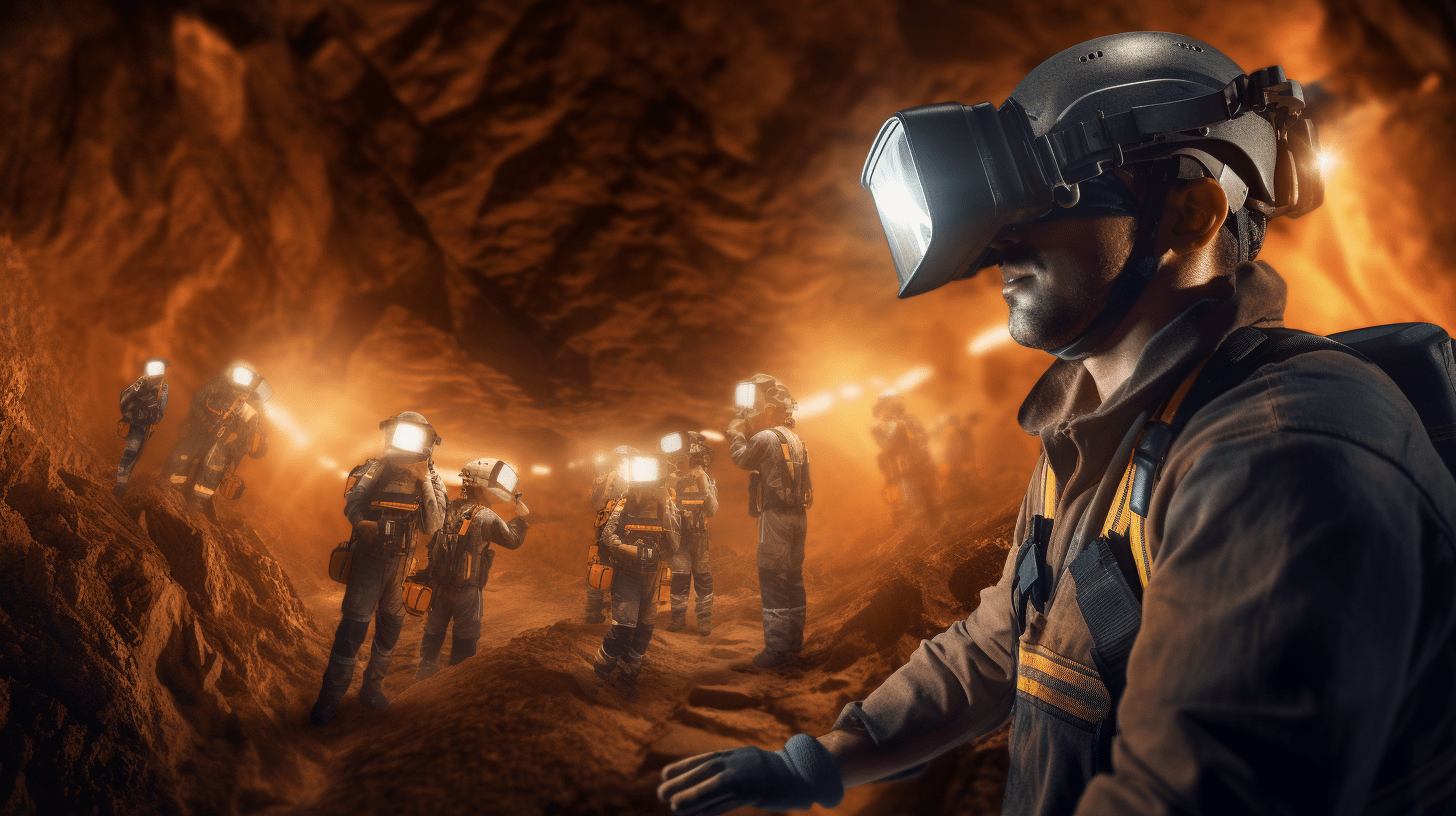
Virtual Reality (VR) is a technology that has been around for quite some time, but only recently has it been making significant strides in various industries. The mining industry is one of these industries, and it has a lot to gain from the implementation of VR technology. With this technology, miners can experience realistic simulations of different scenarios, environments, and equipment, which can help improve safety, efficiency, and productivity.

According to IMSS, the average cost of an industry-related accident is US$10,000. The mining industry has some of the highest accident rates of all sectors. In order to lower those costs, it is crucial to concentrate on security and accident avoidance, according to Luis Valenzuela, Director of the Project Management Office at Abacus IT.

Managers and mine operators may work in a more secure and productive environment thanks to virtual training. The teams can practice their skills before entering the mine thanks to VR training.
Source Link:- 


When virtual reality gets cheaper than dating, society is doomed.

Areas of Mining in which VR can help:-

Training

Mining is a hazardous industry that requires workers to be highly skilled and trained. This is where VR technology can make a significant difference. 

Using VR technology, miners can practice their skills in a safe and controlled environment, without the risk of injury. 

VR training can simulate various scenarios, such as emergency situations, allowing miners to practice their responses and prepare for real-life events.

Training with VR technology can also help miners to understand the complexity of the equipment and procedures involved in mining. 

Miners can be trained on how to operate different types of machinery, such as drills, haul trucks, and excavators. 

They can also learn how to work with explosives, which is a crucial part of mining. VR training can help miners to become more efficient and productive, leading to increased profitability for mining companies.

Planning

Planning is a critical aspect of the mining industry. Mines are complex environments, and planning is essential to ensure that everything runs smoothly. 

VR technology can be used to create a virtual model of the mine, allowing miners to explore and analyze the mine’s layout. 

With this technology, miners can identify potential hazards and inefficiencies before they occur, and make informed decisions to improve safety and efficiency.

VR technology can also be used to simulate different scenarios, such as changes in the mining plan or equipment breakdowns. 

aThis can help miners to test different mining methods and determine the most efficient and cost-effective approach. 

With VR simulations, miners can quickly and easily adjust their plans and make informed decisions.

Safety

Mining is a hazardous industry, and safety is a top priority. VR technology can help to improve safety in a number of ways. 

First, miners can use VR to conduct safety inspections of equipment and identify potential hazards before entering the mine. This can help to prevent accidents and ensure that the equipment is working correctly.

Second, VR technology can be used to train miners on the proper use of safety equipment and procedures. Miners can practice using safety equipment, such as gas masks, hard hats, and harnesses, in a simulated environment. 

This can help them to become more familiar with the equipment and procedures, reducing the risk of accidents and injuries.

Third, VR technology can be used to simulate emergency situations, allowing miners to practice their responses and improve their preparedness. This can help to reduce the risk of injuries and fatalities in the event of an emergency.


    • Four-time faster in VR training than in conventional classroom training


    • 3.75 times more involved emotionally with the subject taught by VR.This is because emotional connection generally improves understanding in people.


  • 4 times more concentrated than e-learning

What is virtual reality, but the Spotify of human experience?

Conclusion

Virtual Reality technology has the potential to revolutionize the mining industry.

It can be used for training, planning, and safety, and can help to improve efficiency, productivity, and profitability. 

By providing a safe and immersive environment for training and planning, miners can become better equipped to handle the challenges of their job. 

By improving safety, VR technology can help to prevent accidents and injuries, reducing the risk of fatalities in the mining industry.

As the technology continues to advance, we can expect to see more widespread adoption in the mining industry, leading to improved safety and profitability for mining companies.