
Football events—whether it’s the World Cup, Euros, or even high-energy local leagues—pull in massive attention. Fans don’t just watch; they interact, predict, compete, and share. For brands, this creates a rare window where engagement comes naturally. The problem is, during these moments, everyone is trying to ride the same wave. When ten booths or campaigns offer similar penalty shootout games with a logo slapped on top, most of them blend into the background.
This is where Custom Football Game Development changes the equation. Instead of starting with a generic template, you start with your marketing KPIs—lead generation, dwell time, brand recall, or data capture—and build the game around those goals. The mechanics, visuals, pacing, and rewards are all designed to support your objective, not just fill screen space.
Prebuilt solutions still have their place, especially for fast campaigns or limited budgets (as covered in our World Cup Marketing Games guide). But when a brand wants to own a truly distinctive moment, a fully custom football game delivers that edge.
Why Choose a Fully Custom Game Over a Template?
(The Real Benefits for Brands)
A fully custom football game is not just a “better-looking” version of a template game—it is a fundamentally different asset. The biggest advantage is creative freedom. When you start from scratch, every element of the experience is open for design: gameplay mechanics, progression, rewards, visuals, and even how long a player spends inside the game. You are not constrained by what a template allows or where a logo can be placed. The game is designed to feel like your brand, not an advertisement wrapped around someone else’s idea.
The second major benefit is full IP ownership. With custom football game development, the code, art, and mechanics belong to you. This means the game can be reused across multiple campaigns, events, or regions without licensing concerns. You can evolve it year after year—add new features, reskin it for different tournaments, or localize it for different markets—without rebuilding from zero.
Data and analytics are another key reason brands invest in custom builds. Unlike generic games with limited tracking, a custom game can be engineered around your data goals. From detailed player behavior and engagement time to lead capture, quiz responses, and conversion triggers, the data you collect is purposeful and actionable.
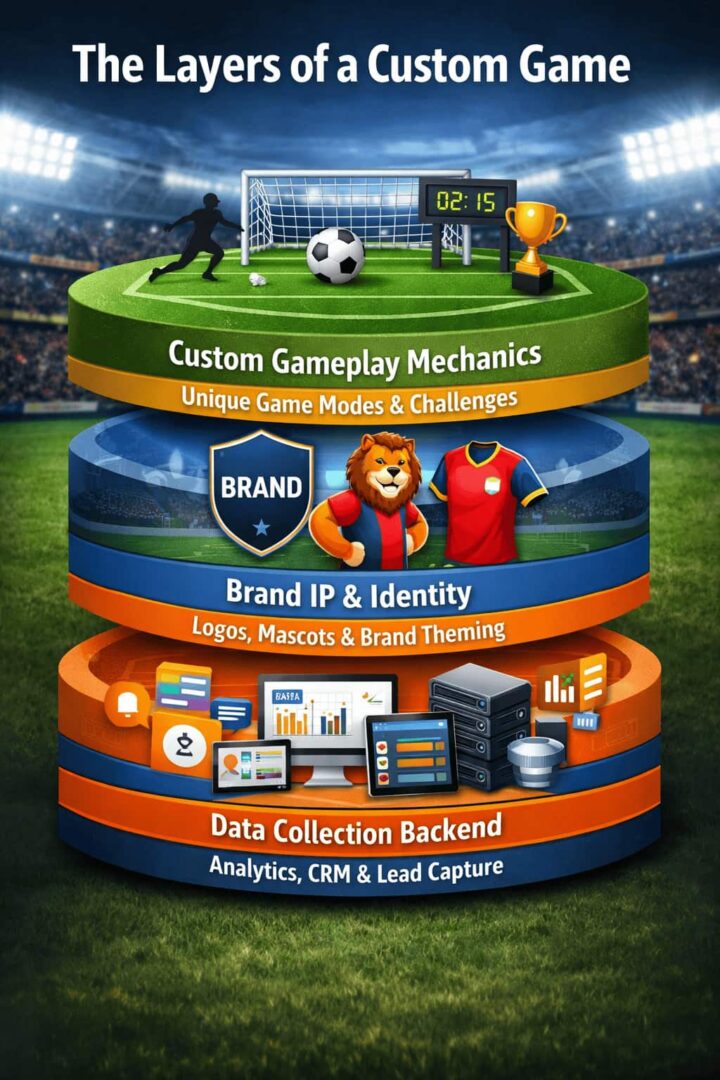
There is also performance and reliability. Custom games are optimized for your exact deployment environment—tablets, kiosks, LED walls, or offline event setups—reducing crashes and friction during high-traffic moments.
Ultimately, premium pricing buys strategic alignment. You are not paying for a game; you are investing in a branded engagement tool built specifically to deliver measurable marketing outcomes.
Customization Options: Art, Features, Branding
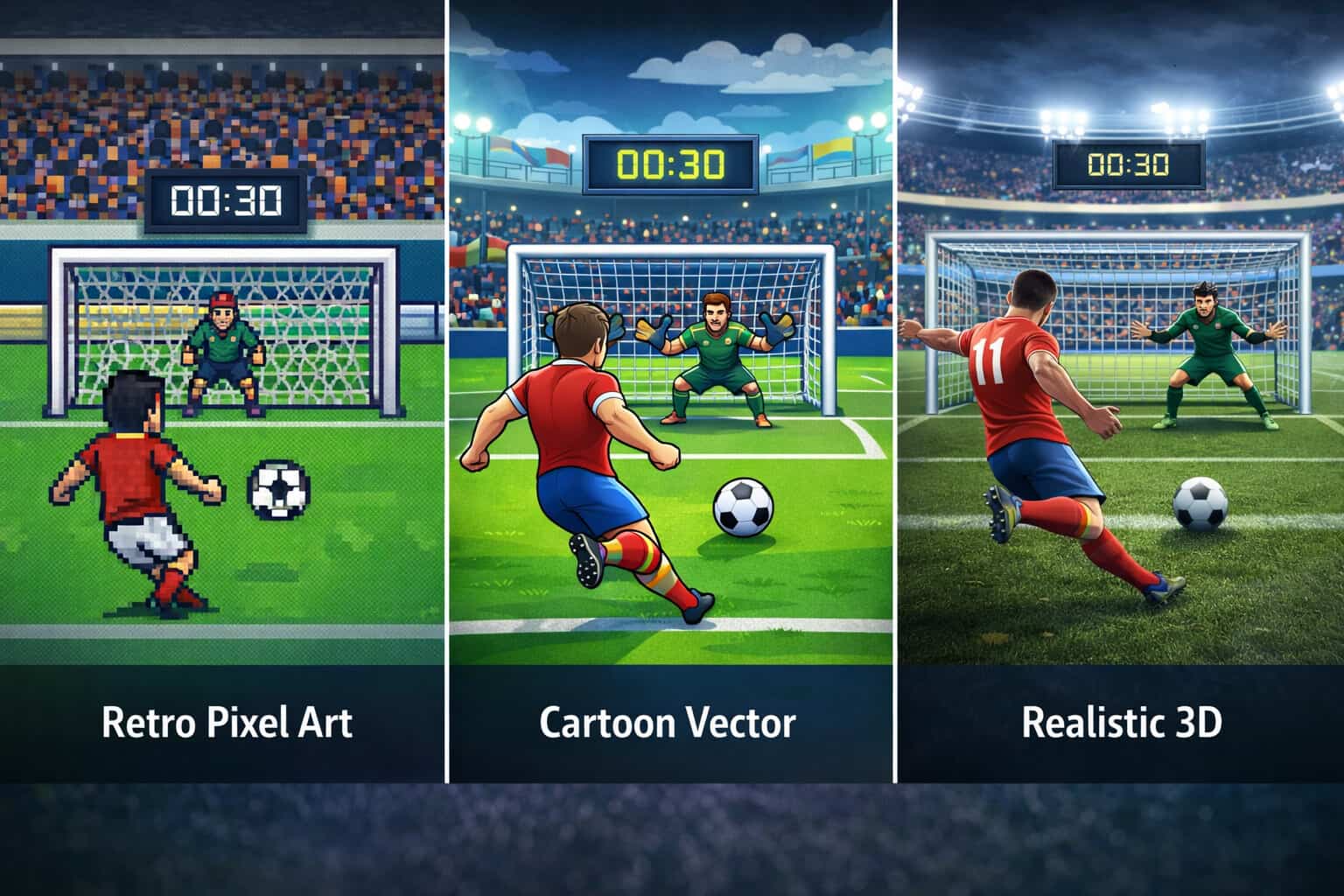
One of the biggest advantages of custom football game development is the ability to shape every visible and invisible element around your brand. Instead of adapting your identity to a fixed game, the game adapts to you. This is where clients usually start visualizing their own campaign coming to life.
Art & Visual Style
The look and feel of the game can be aligned precisely with your brand tone:
- 3D realistic stadiums for premium or sportswear brands that want broadcast-style immersion
- Stylized or low-poly 3D for fast-paced, playful event games
- Pixel or retro art for nostalgia-driven or youth-focused campaigns
- Minimal UI-first design for corporate or B2B activations
Gameplay Features & Mechanics
Custom development allows mechanics to be designed around engagement goals:
- Skill-based penalty kicks or free-kick challenges
- Reaction-based goalkeeper saves
- Trivia + gameplay hybrids to educate while entertaining
- Progressive difficulty, levels, or timed challenges to increase dwell time
Branding & Marketing Integrations
Brand presence goes far beyond a logo on the scoreboard:
- Branded characters, jerseys, stadium banners, and crowd visuals
- Custom win animations, sound effects, and brand voice moments
- Lead capture forms, QR codes, coupon unlocks, or prize mechanics
- Integration with CRMs, email tools, or event dashboards
This depth of customization ensures the game doesn’t feel like an ad—it feels like an experience designed specifically for your audience and campaign.
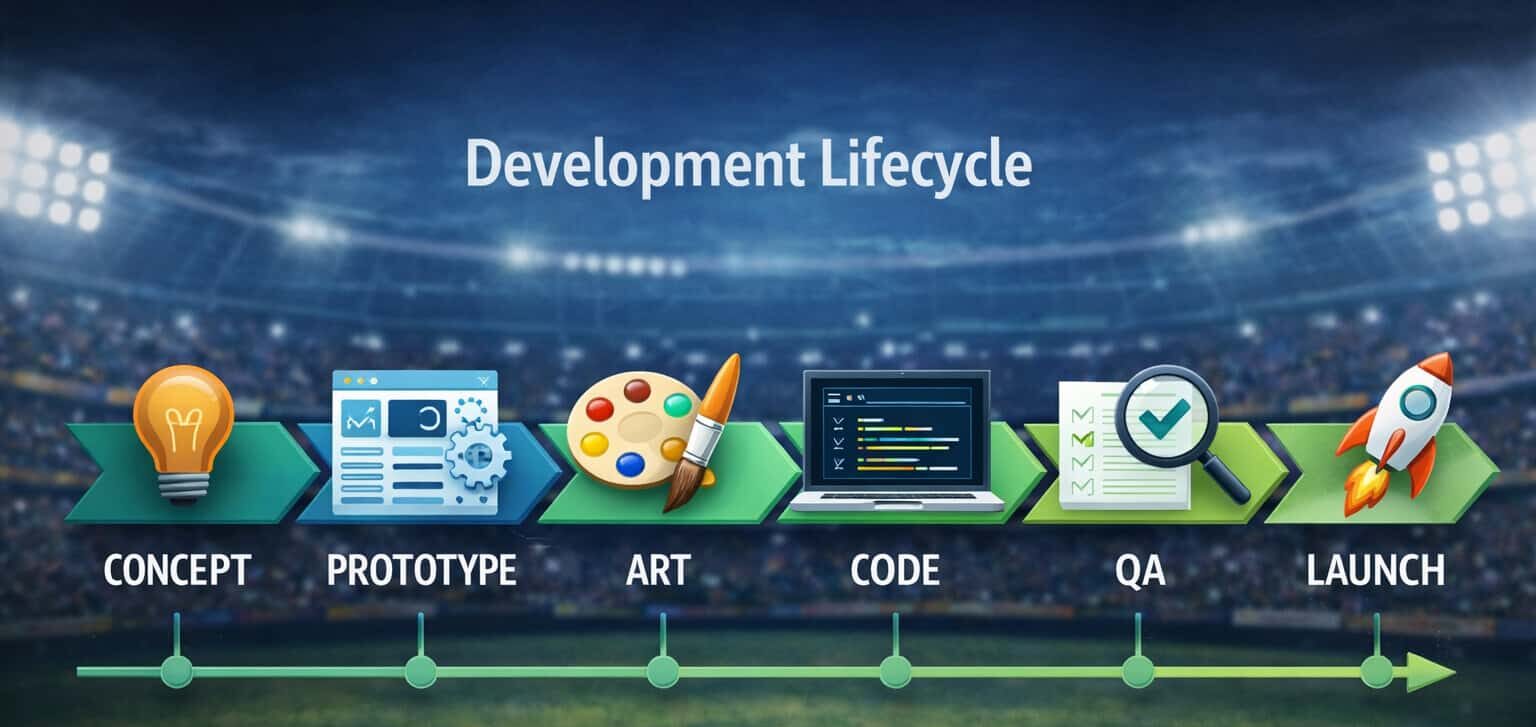
The Development Lifecycle
A fully custom football game is not built in isolation or rushed into production. For corporate campaigns, especially those tied to major football events, a structured development lifecycle is critical. It ensures predictability, quality, and alignment with business goals—not just a good-looking game.
1. Concept & Objective Definition
Every project starts by defining the why. We align on campaign goals such as lead generation, booth engagement, dwell time, or brand recall. This stage covers audience profiling, platform selection (web, mobile, kiosk), and success metrics.
2. Game Design & Player Flow
Once objectives are clear, we design the core mechanics and player journey. This includes gameplay rules, scoring logic, session length, and how users move from “start” to “completion” without friction. Wireframes and flow diagrams are shared early to avoid assumptions.
3. Art Direction & Branding
Visual style, UI design, sound cues, and brand elements are developed together. Whether it’s realistic 3D stadiums or a stylized look, this phase ensures the game visually aligns with brand guidelines and campaign tone.
4. Development & Integration
The game is built using a modular approach, allowing features like leaderboards, lead forms, or analytics to plug in cleanly. Performance optimization, device compatibility, and offline handling are addressed here.
5. QA, Testing & Refinement
Before launch, the game undergoes functional testing, device testing, and edge-case validation—especially important for live events where failures are not an option.
6. Launch & Support
Post-deployment, we support rollout, monitor performance, and provide quick fixes if needed. For many clients, this also includes post-campaign enhancements or reuse for future activations.
This structured process is what turns a game into a reliable marketing asset, not a risky experiment.
Technical Considerations & Engines
Choosing the right technology stack is critical in custom football game development, especially when the game is part of a high-traffic campaign or a live event. The decision is not about trends—it’s about reliability, performance, and deployment context.
Game Engines & Platforms
For rich visuals and cross-device consistency, Unity is often the preferred engine. It allows deployment across kiosks, tablets, mobile devices, and even WebGL, making it ideal for event-based activations and branded installations. For lighter, browser-first campaigns with minimal graphics, HTML5-based engines (such as Phaser or Three.js) can be more efficient, offering faster load times and simpler hosting.
Performance & Server Considerations
Server load planning is essential, particularly for games with leaderboards, multiplayer elements, or lead capture:
- Scalable backend architecture to handle traffic spikes during match days
- Caching strategies to reduce server calls
- Offline or fallback modes for on-ground events with unstable internet
Security & Data Handling
For corporate clients, data privacy matters. Secure APIs, controlled data storage, and compliance with regional data policies are factored in from day one.
By selecting the right engine and infrastructure early, the game remains stable, responsive, and campaign-ready—without surprises at launch.
Prebuilt vs. Custom
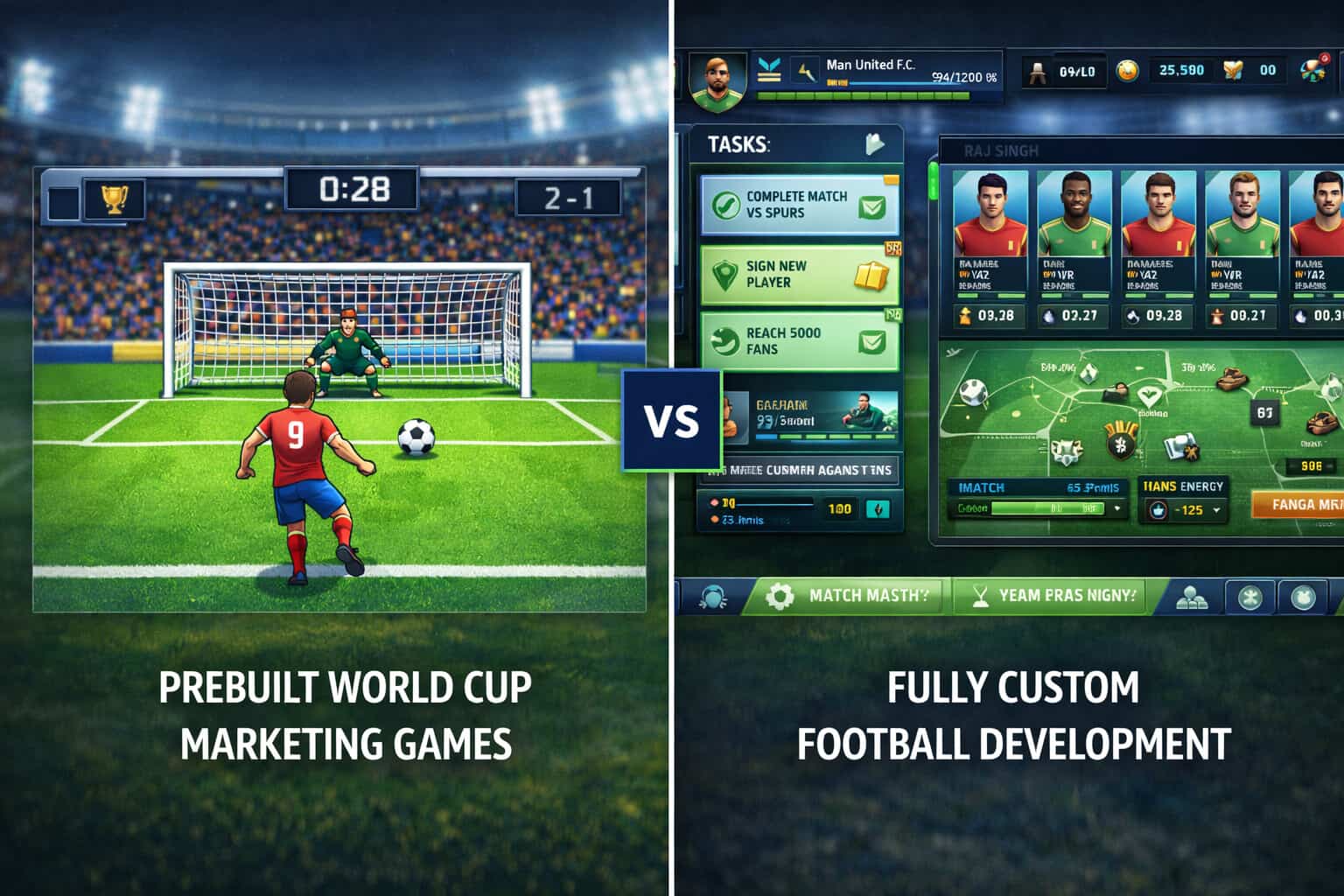
Prebuilt football games are an excellent starting point for many campaigns. They are quick to deploy, budget-friendly, and proven to work for short-term activations—especially when timelines are tight around major tournaments. For brands that want speed and simplicity, these ready-made options make a lot of sense. You can explore examples of such quick-launch solutions in our World Cup Marketing Games guide.
Custom football game development, however, serves a different purpose. It is designed for brands that want deeper engagement, stronger differentiation, and long-term reuse. Instead of adapting your campaign to an existing format, the gameplay, visuals, and features are built around your specific objectives and audience behavior.
In practice, many brands use a hybrid approach—starting with prebuilt games to validate engagement, then moving to a fully custom build when they want to create a standout, ownable experience.
Success Stories / Use Case Example
For a recent football-season campaign, a consumer brand wanted to increase dwell time and qualified leads at multiple event locations. Instead of using a standard penalty shootout template, we developed a custom football game with skill-based mechanics, progressive difficulty, and integrated lead capture tied to score milestones. Players who reached higher levels unlocked instant rewards, which naturally encouraged repeat play.
The result was a noticeable increase in average session time and higher-quality leads compared to previous template-based activations. Because the game was built modularly, the same core experience was later reused for a regional league campaign with updated visuals and branding—proving how a custom football game can deliver value beyond a single event.
Conclusion
Custom football game development is not just about creating a game—it’s about building a branded experience that delivers real marketing outcomes. When engagement quality, differentiation, and long-term value matter, a custom approach makes the difference. If you’re planning a football-driven campaign and want something that truly stands out, let’s discuss how a custom game can be built around your goals. Reach out to explore what’s possible.

